How Facility Teams Can Help Prepare Schools & Universities for a School Year During the Pandemic
Posted on Tuesday Nov 24, 2020 at 04:44PM in New Electrical Products & Technology

How Facility Teams Can Help Prepare Schools & Universities for a School Year During the Pandemic
As the nation waits to find out if their children are going back in-person, online or using a hybrid program, facility teams are already deep into their prep for the upcoming school year. From elementary schools to universities, it seems everyone has questions. As each state and district handles the COVID-19 pandemic in different ways, each facility team is faced with challenges unique to their building. At the end of the previous school year, we were in earlier stages of the pandemic. This led to what Inside Higher Ed called “a herculean effort from faculty and staff across the country” to shift all learning to remote. While many educational facilities have already announced or even started their fall programs, it’s clear that any type of learning could happen—and facility teams need to be ready to adapt quickly.
How are facility teams prepping buildings for school this fall?
The CDC has published guidelines for K-12 administrators and colleges, but most facility teams are facing challenges unique to their situation. Depending on the decisions of the school’s administration and/or district, each facility team is looking at several different options. Common among most evaluating in-person classes, however, are questions like how to best set up each space to minimize the risk of spread, keep students engaged and work within budget. These precautions are necessary even as situations shift daily. There’s also the issue of what they have. Many are working with existing furniture, equipment and buildings. The budget to get things like partitions for desks might not be there, and many classrooms are working with limited space as it is. The six-foot rule may not be feasible, as many teachers and facility teams work to move desks apart while retaining spots for the same number of students pre-COVID. Additionally, teachers have shared emotional concerns about the way this distance impacts learning for children.
Design spaces for new traffic flow in the time of COVID
Whether the educational facility is for K-12 or college, traffic flow is a primary concern. Directional walking is a recommendation from the CDC, which would create a pattern for students to follow. Separation between teachers and students is also vital, and classrooms may need to be redesigned quickly to accommodate a good traffic flow. Research on intentional space design shows that movement is important for optimal learning. Despite the virus, many facilities will have to create unique ways to avoid the classroom from becoming a dead zone. One suggestion from EdSurge includes the use of outdoor space as a great option that accommodates many features ideal for learning and cognitive performance: fresh air, natural elements, plenty of space and movement. Outdoor spaces with power and charging access can extend those learning experiences by giving students a place to plug in laptops and other devices.

University labs face unique challenges
Some classrooms require even more setup. Labs and other unique learning environments utilize a range of equipment specific to their needs, all that require additional considerations like power outlets at each desk, overhead power supply, unique storage and temperature-controlled spaces. University research labs were busy working on critical studies when the outbreak hit, and they’ve seen a shuttering of labs across higher education campuses. But it’s noted that research for some studies simply must go on, and students that are planning to return may need additional lab spaces for classes and other learning experiences.
Special considerations for signage
An added emphasis on proper signage has emerged as a key component of classroom design. As groups of people return together for the first time, it will be important to create specific signage that helps explain the changes. Digital signage can be particularly useful, as it can be changed quickly to spread tips, news and updates across campuses. Commercial monitors and mounts come in handy here.
Flexibility is key for any learning environment
Even outside of labs, many classrooms are looking at situations that now require more spacing than before. Because of this, flexibility is key. Facility teams need to move quickly and adapt furniture to fit recommended guidelines. Previous setups may have pieces that can be carried over, but some fundamentals may change. For example, power sources may have worked against the wall before as many students could share them. It’s now smart to give each workstation its own easy-to-add power source to eliminate sharing, lower transmission risk and make it easier to rearrange desks as needed.
With so many unknowns, facility teams are faced with big challenges. As the school year unfolds, it will continue to be important for each institution to find unique ways that accommodate CDC recommendations and still encourage optimal learning.
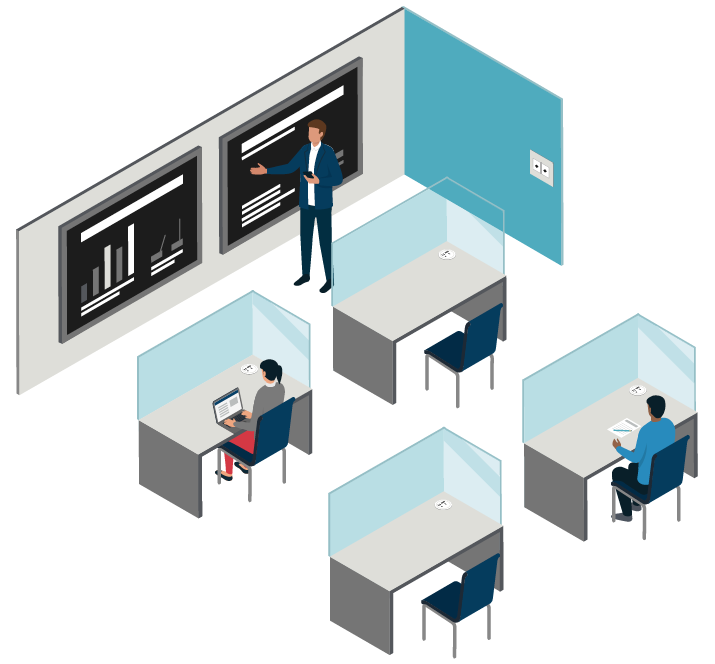
An example of a classroom scenario shows one way that facility teams can set up the room with flexibility for changes during the pandemic: